Which blocks are paper pieced, and how?
FPP Only blocks, the one-sheet paper rule, the max block size, and where the papers print.
Some shapes can't be cut with a standard rotary ruler: sharp star points, irregular shards. Those blocks sew onto printed paper foundations instead. You sew on the printed line, and accuracy comes from the paper, not the cutting. Quilters call this foundation paper piecing, FPP for short, and that's what the FPP marks in the app mean.
FPP Only, marked in the library
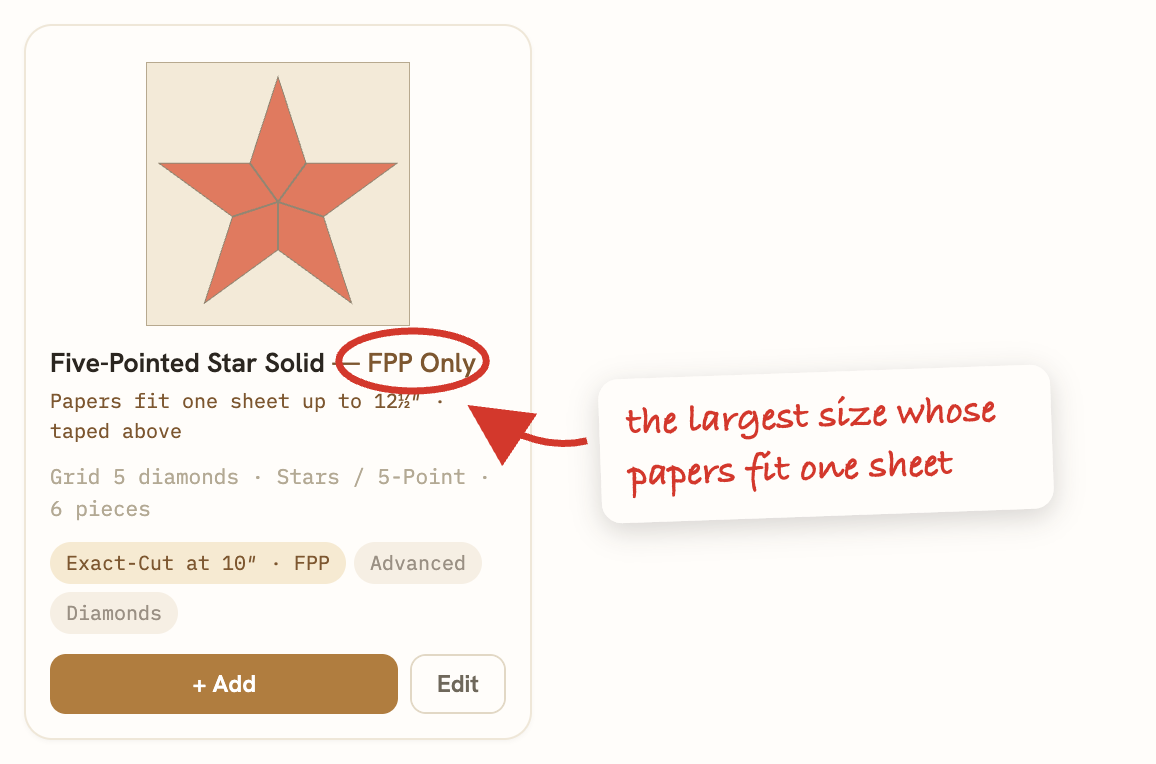
A block that can be made no other way has FPP Only after its name in the Block Library, as Five-Pointed Star Solid does. The largest size whose papers still fit one sheet is right beneath. The FPP Only blocks are the five-pointed and six-pointed stars (Solid and Split) and the four Crazy Patch blocks. Blocks without the mark rotary cut as usual. A few, like Scrappy Strip Block, lead with strip piecing and simply offer an optional paper while it fits.
Taped papers
A foundation prints whole on one 8½ × 11 sheet at 100% while it fits. Past that it prints across several sheets. Cut the later sheet on its ochre CUT line and lay it over the earlier sheet ◆ on ◆. Tape on the blank side inside a large piece, keeping tape off the sew lines (a glue stick works too). The size beneath a block's FPP badge is the largest block whose papers all still fit one sheet.
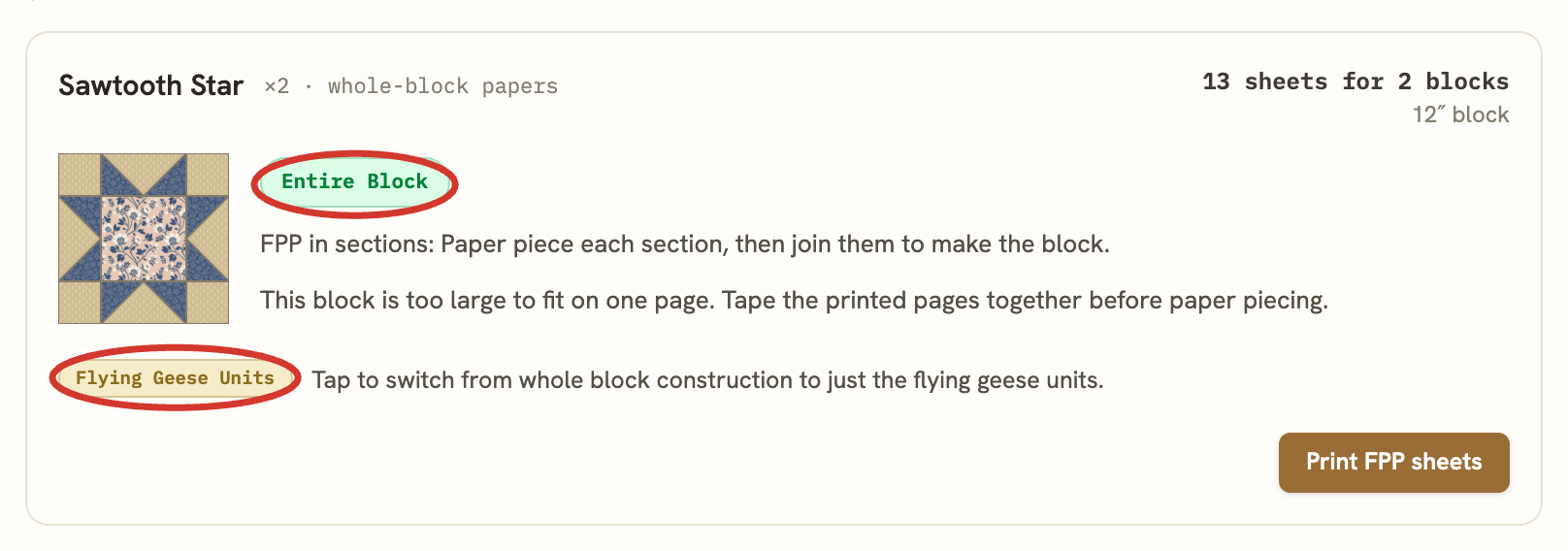
Some blocks can also sew as one piece on papers. Such a block’s card on the Foundation Paper Piecing sheet starts at the whole block. A smaller pill on the card, under its chip, switches to just the unit papers and back. The Solid pointed stars switch between Split-point papers and Whole-point wedges the same way. You make the pick for each block in this quilt. The sheet count in the card's corner, the printout and the page counts all follow it.
How the stars are sectioned
A pointed star sections one of two ways, and the smaller pill on its card chooses. Split-point papers make each point two small papers that join along the point's spine with one straight seam. Then the finished wedges join radiating from the center. The five-pointed stars start here.
Whole-point wedges make each point one paper, diamond and background together, that joins its neighbors on straight seams. The six-pointed Solid star starts here. Small papers are why a star's one-sheet size is generous: it's the paper that must fit the sheet, not the whole block.
What prints, and the fabric you'll need
The Binder's Foundation Paper Piecing sheet prints the papers at 100%. Check the calibration square before sewing. Only FPP Only blocks print their papers inside the Pattern. For every other block, print the papers from this sheet.
Fabric for each numbered region is listed as a rough-cut size: a rectangle cut generous on purpose, so it fully covers its region with allowance to spare. The rough cuts are on the block’s Cut Sheet and on the printed paper piecing pages. Rough cuts are trimmed as you sew. The paper makes the final size exact.
If the block is too big for one sheet
Past the size beneath the badge, the papers print taped across several sheets as above. Nothing stops you. The Block Library says so before you place the block on a quilt (“Papers fit one sheet up to 8″ · taped above”). The block's card on the Foundation Paper Piecing sheet says so at the size you chose: “This block is too large to fit on one page. Tape the printed pages together before paper piecing.” Prefer a single sheet? Shrink the block to the stated maximum.