How to read your pattern
Pieces of a real pattern with the red pen on them: finished vs unfinished vs cut, the circled numbers and letters, CW colorways, rough cuts and subcuts.
StitchBlock Pattern and Cut Sheets: read every page, print at 100%, and cut one block at a time Watch on YouTube, bigger and with chapters
The fastest way to learn a pattern is to look at one. These are pieces of a real StitchBlock pattern — a sampler, so plenty of terms show up — with the marks that matter circled in red. The full symbol list has its own page: How to read the Block Map and Cutting List.
A block’s cutting page, decoded
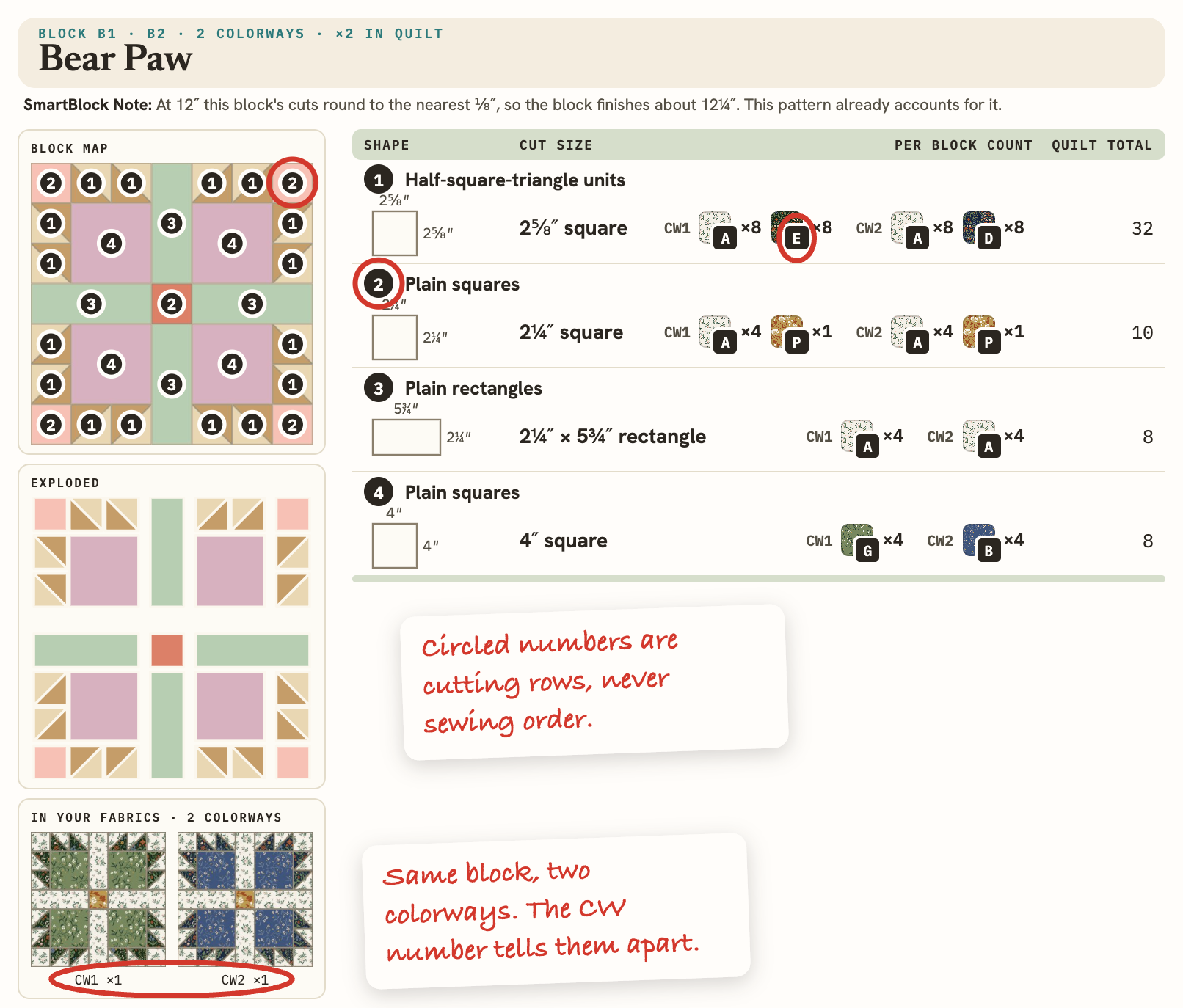
Every block section opens the same way. The line above the block’s name says where the block sits on the quilt, how many colorways it has and how many the quilt needs. It reads like this: BLOCK B1 · B2 · 2 COLORWAYS · ×2 IN QUILT.
The little quilt drawing is the Block Map, and its circled numbers point at rows of the cutting table — never sewing order. Under it are the Exploded view and In Your Fabrics, a small picture of the block in each colorway. The block’s finished size, the size it measures once it’s sewn into the quilt, is on the pattern’s cover as Block size.
The lettered chips on the swatches are fabrics — every letter maps to one fabric in the Fabric Key. And when the same block appears painted two ways, the thumbnails wear CW numbers — colorways — so the cutting table can say which copy each count belongs to.
Notice the SmartBlock Note under the header: when a block’s cuts round to the ruler, the pattern says so and quotes what the block really finishes at. That’s not an error to fix — the pattern’s own numbers already account for it.
Finished vs cut — the ½″ the seams take
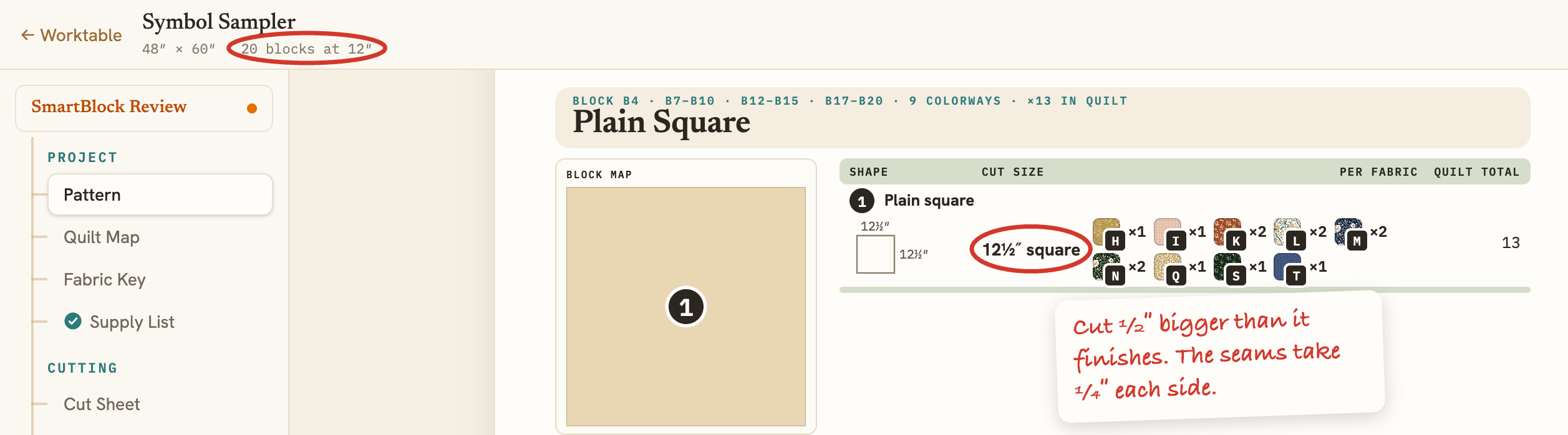
Three sizes run through every pattern, and each answers a different question. Finished is the size a piece measures once it’s sewn into the quilt — the seams have taken their share. Unfinished is a piece’s size before it’s joined to its neighbors: finished plus the ¼″ seam allowance on each side, so finished plus ½″ overall. Cut is the number the cutting table literally tells you to cut — for most pieces the cut size IS the unfinished size, exactly like this 12″ square cutting at 12½″.
Unfinished — the number you true to
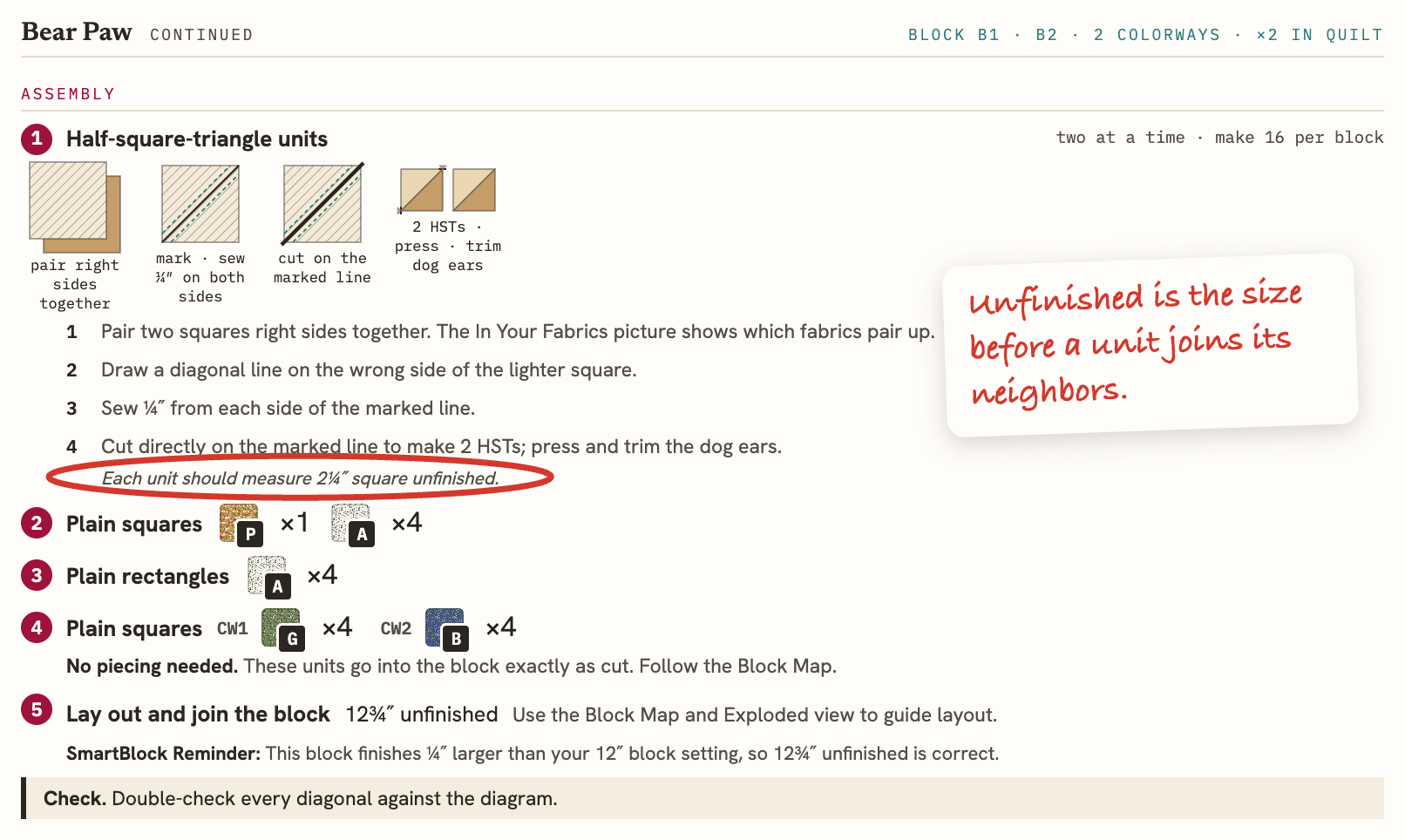
Under ASSEMBLY on a block’s page, each unit has a check line like the one circled above: “should measure 2¼″ square unfinished.” Every block ends with one too: check the measurement, square up if needed, then join. Truing to the unfinished number as you go is what keeps a quilt flat.
Rough cuts and subcuts
Some pieces cut bigger on purpose — a rough cut. Paper-pieced (FPP) fabric is the everyday case: each region’s rectangle is cut generous so it fully covers its spot on the paper, and the trim afterward makes it exact. Sew-and-trim units work the same way — cut generously, sew, trim the unit to its unfinished measurement. When a piece is a rough cut, the pattern says so; it’s deliberate, not a math error.
A subcut is a cut made to a piece you already cut: a strip subcut into squares, or a square subcut on both diagonals into setting triangles. When a pattern says subcut, the first cut is just the errand — the subcut is the piece you keep. This sampler cuts every piece directly, so no subcut lines appear on its pages; on-point settings and diamond quilts are where you’ll meet them.
Colorways — the CW numbers
A colorway is the same block painted differently. Whenever one block is placed in more than one colorway, every surface that names a specific combo — cutting tables, printed pages, labels — appends CW1, CW2… so the repeats are tellable apart. Numbering follows placement order and stays consistent: CW2 means the same combo on every sheet. A block placed in only one colorway keeps its plain name. How colorways are born — and brought back in line — lives in Paint fabrics onto your quilt.
Which number, when
The quilt’s dimensions and the Layout tab talk finished — you’re planning the quilt. The cutting tables give cut sizes, marked as rough cuts where a piece is deliberately generous. Assembly steps give the unfinished size: “Check that the block measures 10½″ unfinished.” The Dies tab lists finished with unfinished in parentheses, and the Quilt Map prints both.
Tip: Holding the rotary cutter? The number you want is the cut size in the cutting table. Truing a unit? Unfinished. Planning the quilt? Finished.